Unified memory is not new. The PlayStation 4 shipped in 2013 with "8 GB of unified system memory" shared by its CPU and GPU (Sony's specs), and integrated GPUs have borrowed system DRAM for decades. What is new is the scale: bigger pools, much higher bandwidth, and CPUs and GPUs that work on the same data without copying it around. For workloads that move and process a lot of data in parallel, this is almost a no-brainer. However, when different vendors say "unified memory", they can mean unifying very different things.
Unified memory, based on which vendor you ask, can mean one of three things, broadly speaking:
- One physical pool. As seen in Apple's M-series chips: one DRAM pool shared by the CPU and the GPU.
- One address space over separate pools. As seen in CUDA Unified Memory on a discrete NVIDIA GPU. The same pointer works on both sides, but pages still migrate over PCIe when the other side touches them.
- One coherent pool. As seen in NVIDIA's DGX Spark, which NVIDIA describes as a "CPU+GPU-coherent memory model" (press release). Like the Apple chips, the CPU and GPU share one pool. If you know CXL, this is a bit like a Type 2 device: an accelerator whose memory the CPU can access coherently.
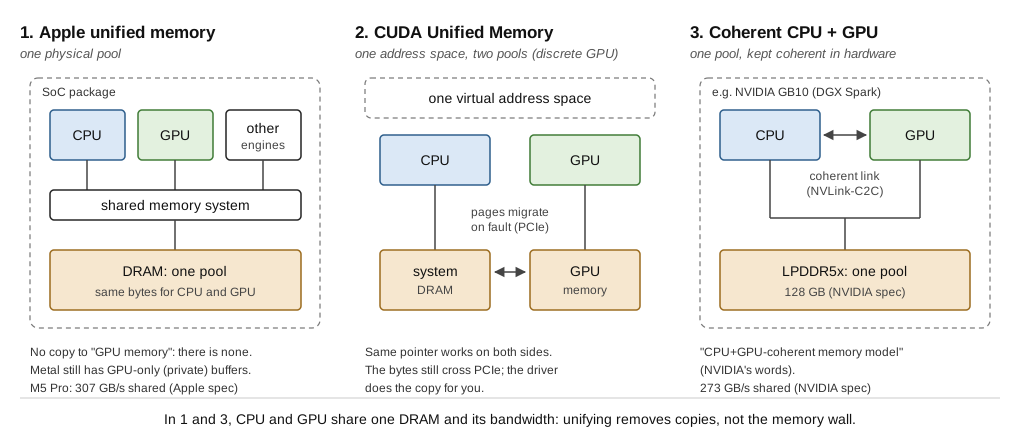
Unifying memory the way Apple has does not mean the GPU gets all of it. On an M5 Pro
MacBook Pro (24 GB, macOS 27.0.1), Metal reports hasUnifiedMemory as
true, yet recommendedMaxWorkingSetSize is 17.76 GiB, or 74% of RAM. Apple
describes that value as "an approximation of how much memory, in bytes, this
GPU device can allocate without affecting its runtime performance" (docs), so it
is a guideline rather than a hard cap. You can check yours with a few lines of
Swift (xcrun swiftc -O q.swift -o q && ./q):
import Metal
let d = MTLCreateSystemDefaultDevice()!
print("hasUnifiedMemory:", d.hasUnifiedMemory)
print("recommendedMaxWorkingSetSize GiB:", Double(d.recommendedMaxWorkingSetSize)/1073741824)
That is capacity, though. Unification removes expensive copies between pools, but the DRAM bandwidth limit remains, and now the CPU and GPU draw on it at the same time. So how does one pool of 307 GB/s (Apple's figure for the M5 Pro) get shared when both sides want it? My hypotheses are:
- Statically split: say the CPU gets 30% and the GPU 70%, fixed in hardware or firmware.
- Shared on demand: the memory system arbitrates between CPU and GPU requests as they arrive. Many SoCs work this way, but I don't know what Apple does.
My bet is static configuration, though I couldn't find anything public from Apple that settles it. The two are easy to tell apart: if the split is static, the CPU alone should stall around 92 GB/s (30% of 307), busy GPU or not. If it is shared on demand, the CPU alone should go higher, then drop once the GPU starts streaming.
Truly unifying memory for different compute elements is a challenging feat, and what Apple and NVIDIA are doing is the latest step towards easing an obvious bottleneck: the memory wall. It also makes big shared-memory machines more accessible, given that you can buy them for reasonable prices (maybe in a few years they will be "dirt cheap" on eBay. A boy can only dream.)